
Literature Review
- Nu'man Kamil
- Aug 19, 2020
- 7 min read

Updated: Oct 2, 2020

2.1 Introduction
This section discusses some literature reviews on the previous technology that has been developed by other researchers. Next, the contrast between the preceding research machine used and the proposed project would be clarified further in this chapter. Then, it will also discuss the possibility for the technology to further expended in the future with additional development may be carried out in order to enhance the performance of the project; which is food dispenser.
2.2 Theory and Basic Principle
2.2.1 Arduino
Ibrahim, M., Zakaria, H., & Xian, E. W. (2019) said that Arduino as the microcontroller; regulated the process to run the system with a given of fixed time. M Ibrahim also stated that it is necessary to have a prototype to undergoes the experiment testing so that the process will run smoothly without any problem involving the mechanical part of the project as well as Arduino program. According to Dada, E. G., Theophine, N. C., & Adekunle, A. L. (2018), Arduino can also act as a timer. In placing more emphasis, Jesheenaa, M. A., Jeevika, M. A., Divya, M. D., Sandhiya, M. R., & Kathiresan, M. A (2020) claimed that Arduino also has a system that can be processed and stored database of human. Furthermore, in observation-based study by Sangvanloy, T., & Sookhanaphibarn, K. (2020), the findings have shown that the Arduino IDE program is an open-source program written in the languages of C and C++. It is used for program writing and uploading to compatible Arduino boards and other vendor creation. And for its open-source, this software is often used widely by programmers.
2.2.2 Radio-Frequency Identification (RFID)
Jesheena et al. (2020) introducing RFID as a system that has high transparency wherein the smart card and Arduino interlinked to each other. In addition, a tiny radio-frequency transponder called an RF tag is used, which is, electronically programmed with specific remote-readable data. It operates at frequencies between a few hundred kilohertz (kHz) and many gigahertz (GHz). The RFID reader transmits to the tag the power and information needed. There are two forms of RFID marks which is; active and passive. Actives labels are battery-powered and use higher frequencies and need higher costs, whereas lower frequencies used by passive tags and do not have an internal power source.
2.3 Review of Previous Relate Work
2.3.1 Design and Fabrication of a Prototype Automated Instant Noodle Vending Machine
The goal of the project is to enable individuals, particularly those working in call centres, to eat noodles quickly and efficiently during their short breaks. The specific aspect of this instant noodle vending machine is that, during dispensing, it prevents the use of plastic or paper cups. Instead, cooked noodle mix is pass out directly into the user's provided mug. The dispensing process is systematic, beginning with the detection of the cup, the dispensing of crushed noodles, the dispensing of seasoning based on the desired taste, and finally, the injection of water. The instant noodle vending machine provides options to choose from three different flavours, namely beef, chicken, and spicy beef. Instead of standard noodles, crushed noodles used to avoid spoon and fork use. Also, only by drinking from the bowl, the noodle mix can all be eaten immediately.
Figure 2.1
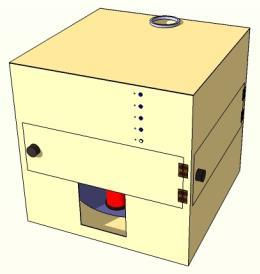
It is also equipped with eco-friendly and time-saver special features; the system does not use plastic or paper cups for dispensing. Also, it saves time and effort compared to current noodle vending machines where the user manually opens a pre-packed noodle mix. This project is distinct from various types of vending machines since it does not exist in the Philippines at present. In malls, side streets, and offices, it is not possible to find this sort of instant noodle machine. Particularly in call centres where time is of great importance, this reduces the hustle of unpacking existing cup noodles. It is a prototype, which ensures that it is subject to main and precise changes in general. Overall, the project's goals were able to successfully achieved by the researchers. (Biglete, E. R., Landicho Jr, M. M., Quicho, F. R. V., & Sauli, Z. 2018).
2.3.2 Automatic Multi-Purpose Ration Dispenser Machine
In India, in fair price shops, called the Public Distribution System; ration dispenser machines are aboard. Earlier, the public distribution system contained a lot of malpractice and abuse in the civil supply, such as deviation in the number of ration products supplied, to wait in line for a long time, which was a huge disadvantage for a customer and time-consuming. Transparency would be much better by implementing this scheme. Consumers databases will be accessed and stored on the Arduino microcontroller. RFID, GSM, Arduino Microcontroller and Voice Recognition System are the core components used in this system.
Figure 2.2

This project removes false ration card holders and safeguards the regular people's interest in ensuring that the food security of the country and the level of corruption can decline. The choice of goods and quantities would make the system smarter and more stable, allowing the economy of the country to hit new heights. You can prevent malpractices by using this method since there are no manual activities and all information is stored in the database as well. It is also easy to cross-check the data at any stage for greater authority. Jesheena et al. (2020)
2.3.3 Arduino UNO Microcontroller Based Automatic Fish Feeder
Automatic fish feeders are electronic devices capable, at current intervals, of dispensing fish food. They consist of timing circuitry to keep track of time and a trigger or switch that uses a motor to activate the dispensing mechanism. The back-and-forth movement of motor regulates the quantity of food dispensed depending on the time of food release and closure.
It started when the AC supply from the power source being step down as the voltage of an AC which usually high, say 220V. The transformer will step down the high voltage as low as 5V. This 5V voltage will flow through a full bridge rectifier to rectifies from AC to DC. The capacitor will act as the filter to get rid of the ripples. The 7805-voltage regulator monitors the voltage to stay at 5V. The LED shows a constant 5V from the circuit used and is unable to handle voltage above 5V. To operated LED, the resistor plays a vital part, in turn, the step-down voltage to a lower voltage
The necessary materials are quite simple; the device produced using plastic as the device's body needs to be highly stable to carry all electronic components. Moreover, because of its lightweight and inexpensive, plastic is chosen. The software code was written in the language of C programming and burned to the microcontroller. In the end, fish be fed at the necessary periods while the owner is travelling or too busy to adhere to the daily feeding schedule, which would be helpful. Dada, E. G. et al. (2018)
2.3.4 Pet Food Auto Feeder by Using Arduino
An automated pet feeder is a machine which can replace the method of manual feeding that can be set-up at the appropriate amount and time of feeding. It used to solve the pet owner's forgetfulness to feed their pet and to prevent further expenses by leaving them at a pet hotel. The goal of this project is the design and development of a pet feeder mechanism. As a microcontroller, Arduino is used to controlling the process and run the device for a fixed time.
By using Solid Works, the planned and detailed drawing generated. The prototype produced and experimentally tested on the mechanism to ensure that the feeding process runs smoothly without any mechanical obstruction. In the end, the target of the automatic pet feeder accomplished by the use of the Arduino. The material used here is High-Density Poly Ethylene (HDPE). Adding the rotary bladder to rotate the pet food when the mechanism moved, is a suggestion for enhancing the design of the pet food jar. It is to reduce the risk of the pet food being trapped at the end of the container in case the compactness of the pet food happens. M Ibrahim et al. (2019)
Figure 2.3

2.3.5 Automatic Pet Food Dispenser by using Internet of Things (IoT)
The goal of this project is to create a feeder to assist small pets such as cats and dogs with the Internet of Things in assigning dry food diets. Whenever a pet owner is outside the home and unable to feed the pets, it will be so much helpful. When free-feeding happens, it can cause pets to become obese and can also be applied to track the feeding habits of pets to train them for scheduled meals.
The system can be divided into software and hardware. Software is a programming part to control various devices and provide a user interface like Arduino IDE and Blynk. Hardware is an assembly of equipment into the project such as Arduino board, motor, Wi-Fi microcontroller and sensor. Design the dispenser using 3D design software and built the final product with acrylic. Acrylic used to make the dispenser strong, robust, and better than the conventional system to withstand the environment and also able to withstand heat from sunlight. C and C++ are the languages used to design this project, as it is easy to understand, especially writing code for microcontrollers such as Arduino.
Figure 2.4

The suggested pet-food feeding machine is the solution to the issue and helps to take care of the animals more effectively. If the owners feed their pets on their own, using this system would be different from the usual way, with more precise feeding on time as we set; could be managed from a distance that could not be usually be archived. Sangvanloy, T. et al. (2020).
2.4 Summary of the chapter
To summarize, the chapter is discussing the journals done by the previous researchers. The topic that has been discussing is about the components such as Arduino and FRID. Reviews of earlier studies have also carried out, which will provide a clear picture of the development of this project.
The first journal that has been review is from Biglete, E. R and his friend which is; ’Design and Fabrication of a Prototype Automated Instant Noodle Vending Machine’. This project is focusing on how to make the vending machine solved the problem of eating noodles so that it will be quickly and efficiently during workers short breaks. The second one is ‘Automatic Multi-Purpose Ration Dispenser Machine’ that solve the problem of corruption and malpractice in civil supply in India. The concept is to control the ration dispenser from being taking advantage of irresponsible people by upgraded it into the automated use machine.
Next, ‘Arduino UNO Microcontroller Based Automatic Fish Feeder’ and ‘Pet Food Auto Feeder by Using Arduino’. These two projects are quite different as it is specifically designed for fish or animal and not for the use of human. It used the same idea as the automated based food dispenser where it releases a specific quantity amount of food at a specified time. The last one is ‘Automatic Pet Food Dispenser by using Internet of Things (IoT)’ which the only difference in this project is the use of IoT as the component that monitors the data of the project.


Comments